The Forum's first session, themed "Localities Working Together - Discussing Global Governance"
The international assembly brought together high-ranking officials from six Mekong-Lancang nations, including Vietnam, Laos, Thailand, Cambodia, and Myanmar. Leading the Chinese delegation were Mr. Wang Ning, Secretary of the Yunnan Provincial Party Committee, and Mr. Yang Wannian, President of the Chinese People's Association for Friendship with Foreign Countries.
The Tuyen Quang provincial delegation was headed by Mr. Phan Huy Ngoc, Deputy Secretary of the Provincial Party Committee and Chairman of the Provincial People's Committee. He was joined by Ms. Pham Thi Minh Xuan, Vice Chairwoman of the Provincial People's Council, along with key leaders from the Department of Foreign Affairs and the Office of the Provincial People's Committee.

Mr. Phan Huy Ngoc, Chairman of the Provincial People's Committee, attending the Forum
The "Mekong-Lancang Local Government Cooperation Forum and Historical and Cultural Cities Dialogue 2025" started in 2021 and has been successfully held three times. It serves as an important platform for local Mekong-Lancang governments to promote friendly relations and seek mutual construction and development. This year's Forum was themed "Empowering Localities, Creating Opportunities – Working Together to Build a Future Along the River," and included the following contents: Opening Ceremony, Local Government Cooperation Forum, Historical and Cultural Cities Dialogue, and Exhibition of Intangible Cultural Heritage.
Delivering a speech at the Forum, Mr. Phan Huy Ngoc, Deputy Secretary of the Provincial Party Committee and Chairman of the Provincial People's Committee, affirmed: Vietnam and China are two neighboring countries with contiguous mountains and rivers, and the people of both nations share a long-standing tradition of friendship. Since the establishment of diplomatic relations on January 18, 1950, the relationship between the two countries has been continuously consolidated and developed. The two Parties, two States, and peoples of the two countries always maintain friendly relations under the guideline of the "16-character motto" (friendly neighbors, comprehensive cooperation, long-term stability, and looking toward the future) and the "Four Goods" spirit (good neighbors, good friends, good comrades, and good partners).
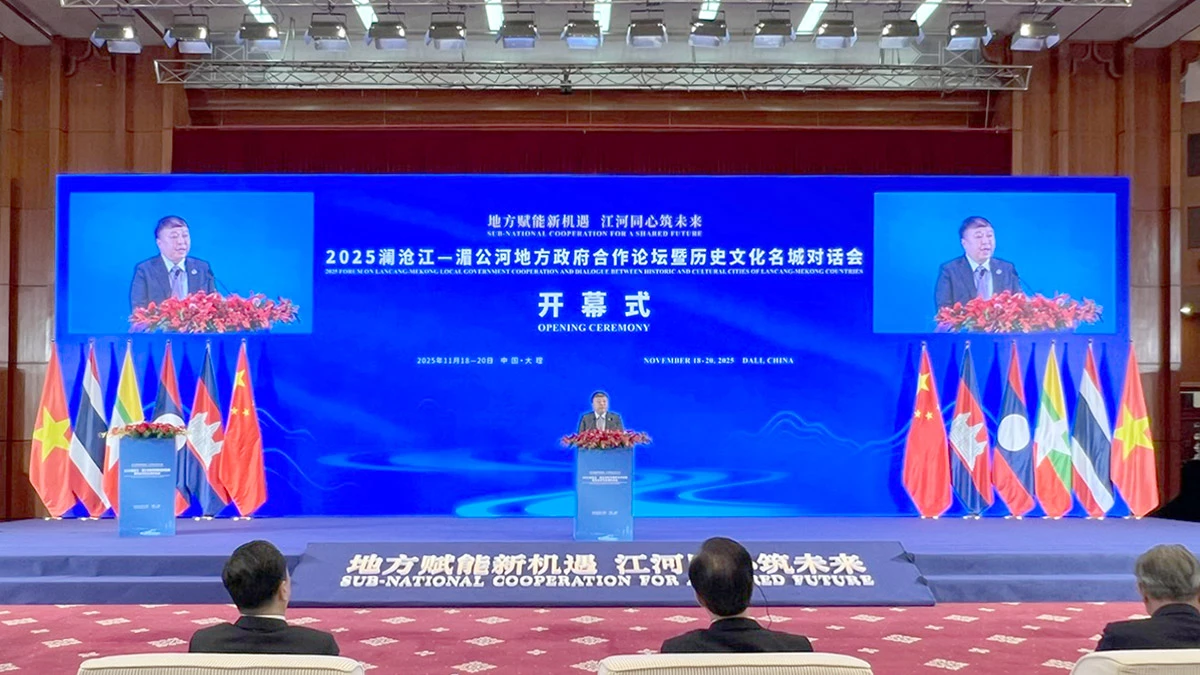
Chairman of the Provincial People's Committee Phan Huy Ngoc delivering a speech at the Forum
Chairman of the Provincial People's Committee Phan Huy Ngoc clearly stated: China is currently Vietnam’s largest trading partner; and Vietnam is China’s largest trading partner within ASEAN. In 2024, bilateral trade turnover exceeded $205 billion USD, demonstrating the strong, substantive, and sustainable development trend in cooperation between the two countries. These are significant milestones, reflecting the strategic vision of high-level leaders, as well as the active support and response from the peoples of both nations.
In addition to general cooperative relations, Vietnam–China cooperation at the local level is increasingly valued and effectively implemented. Localities in Vietnam and China’s Yunnan and Guangxi provinces have maintained successful activities in delegation exchanges, investment promotion, trade, tourism cooperation, agriculture, education and training, and climate change response.
Providing information on the province's socio-economic development conditions, the Chairman of the Provincial People's Committee stated: Tuyen Quang is a northern mountainous province of Vietnam, rich in history, culture, and revolutionary tradition. It possesses many scenic spots classified as National Special Relics, notably the Tan Trao National Special Historical Relics Site and the UNESCO Dong Van Karst Plateau Global Geopark. This area is a convergence of outstanding values regarding geology, geomorphology, biodiversity, and culture; it is home to many ethnic minority communities with unique systems of festivals, customs, and traditional architecture. These values create a vital foundation for Tuyen Quang to develop ecotourism, community tourism, and cultural tourism associated with heritage preservation and the promotion of local identity.
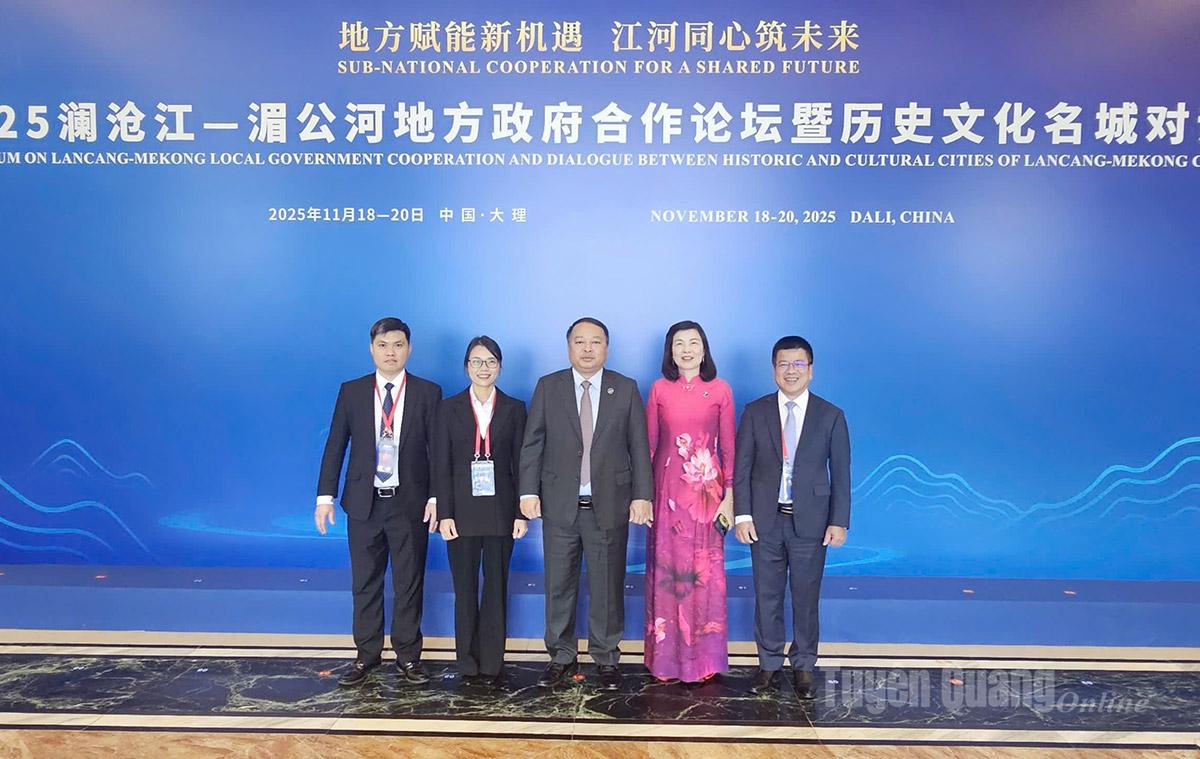
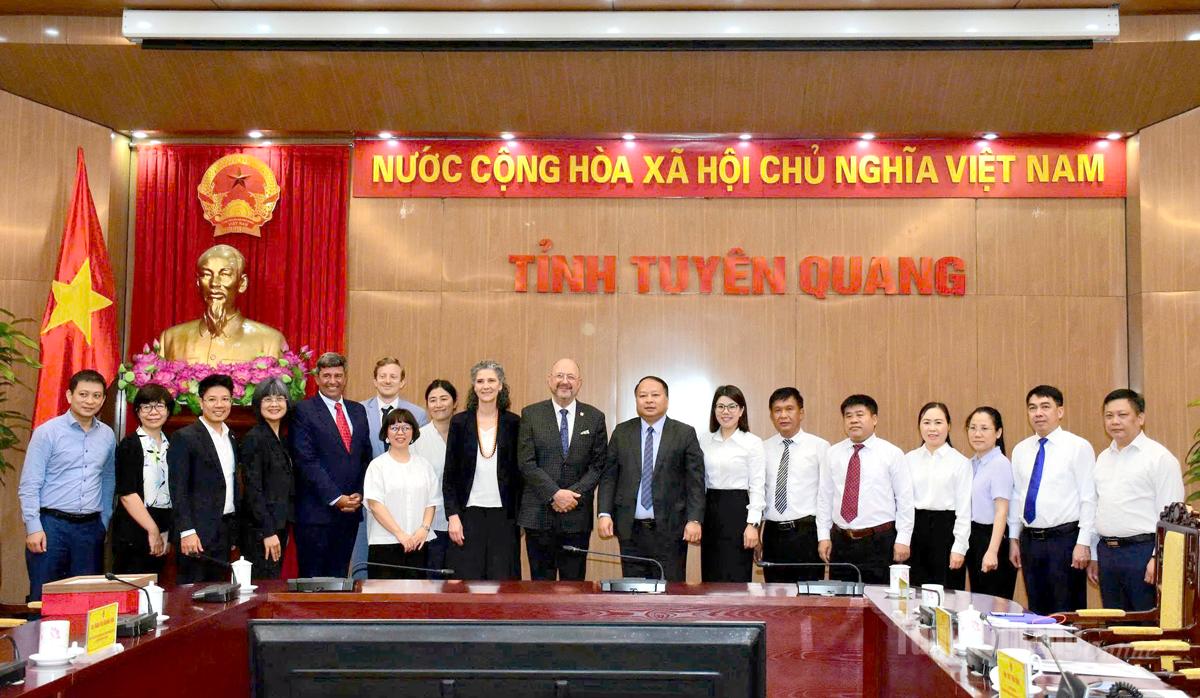
Chairman of the Provincial People's Committee Phan Huy Ngoc with members of the Tuyen Quang provincial delegation participating in the Forum
Furthermore, the province is oriented towards developing the green economy and circular economy; promoting high-tech agriculture and forestry, deep processing of plantation wood, medicinal herbs, and aquatic products. It also focuses on developing commerce, services, and logistics infrastructure to serve regional connectivity and international integration. Notably, following administrative consolidation, Tuyen Quang is entering a new development phase with many outstanding potentials and advantages, favorable geographical location, abundant resources, a safe investment environment, and a proactive government that supports businesses.
Chairman of the Provincial People's Committee Phan Huy Ngoc welcomed the initiative of the Organizers to choose the theme "Empowering Localities, Creating Opportunities – Working Together to Build a Future Along the River." He stated this is a meaningful message that affirms the spirit of solidarity and shared responsibility for sustainable development among Mekong-Lancang riparian localities and is precisely the orientation for cooperation between the two countries' localities.
He proposed the need to continue strengthening friendly exchanges and sharing experiences between localities in: cultural heritage preservation, building civilized urban centers, and developing sustainable and community-based tourism, emphasizing that culture is the bridge for mutual understanding and long-term cooperation. He also proposed promoting economic, trade, and investment cooperation; establishing network supply chains for agro-forestry, deep processing, high-tech agriculture, and logistics. Tuyen Quang is ready to serve as a regional connection point.
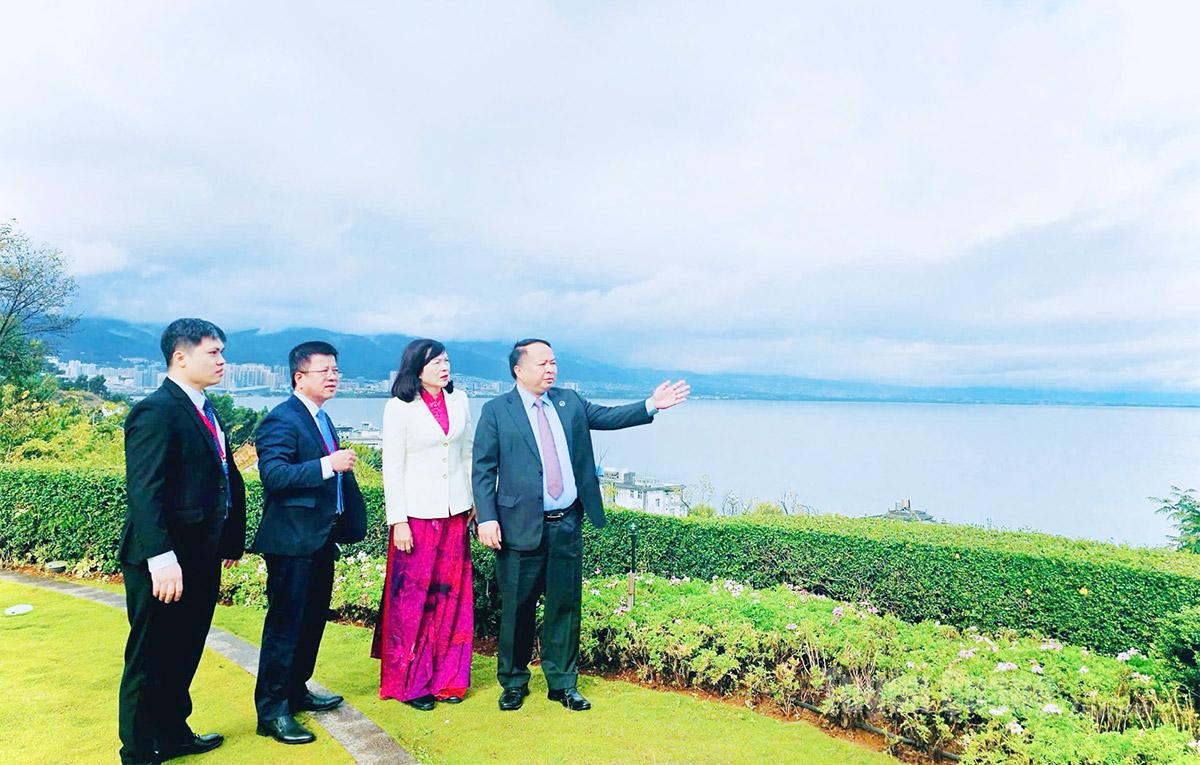
Mr. Phan Huy Ngoc, Chairman of the Provincial People's Committee, and the working delegation surveying the Erhai Lake ecological corridor in the ecological tourism zone of Dali Prefecture, Yunnan Province
He also proposed expanding business cooperation between localities; building a linked economic ecosystem from raw material areas to processing and consumption, thereby enhancing competitiveness and creating sustainable jobs. And effectively leveraging the "Historical and Cultural Cities Dialogue" program to develop new cooperation models based on the soft power, creativity, identity, and heritage of each locality.
Chairman of the Provincial People's Committee Phan Huy Ngoc stressed: With the spirit of cooperation, friendship, and responsibility, Tuyen Quang province is ready to implement specific, effective, and sustainable cooperation programs with all localities in the region. He also extended a sincere invitation to leaders, investors, experts, and international friends to visit and work in Tuyen Quang province to directly explore its potential, advantages, investment environment, and wide-open cooperation opportunities.
The "Mekong-Lancang Local Government Cooperation Forum and Historical and Cultural Cities Dialogue 2025" is an activity aimed at deepening traditional friendship among the six Mekong-Lancang countries, promoting practical local cooperation, strengthening "people-to-people affinity," and contributing to building an increasingly close community with a shared future for the Mekong-Lancang countries.
Nguyen Thanh Hieu
From a Vietnamese news on "tuyenquangonline"