“Activating” the FTA Ecosystem
As international economic integration gathers pace, next-generation FTAs such as the EVFTA with the European Union, the CPTPP with countries across the Pacific and the UKVFTA with the United Kingdom are opening up global markets to Vietnamese goods. Tapping into these opportunities, Tuyen Quang is taking its key products into some of the world’s most demanding markets, including the EU, Japan, the Republic of Korea, the UK and ASEAN countries.
The impact of this market diversification strategy is already evident in the growth figures. In the first six months of 2026, the province’s total import-export turnover reached USD 516.7 million, with exports alone hitting USD 382 million - more than 61% of the annual target. More than 4,000 businesses form the backbone of the province’s productive sector, providing jobs for over 75,600 workers. With greater flexibility and adaptability, leading enterprises have moved to diversify their export markets and respond to changing market demands.
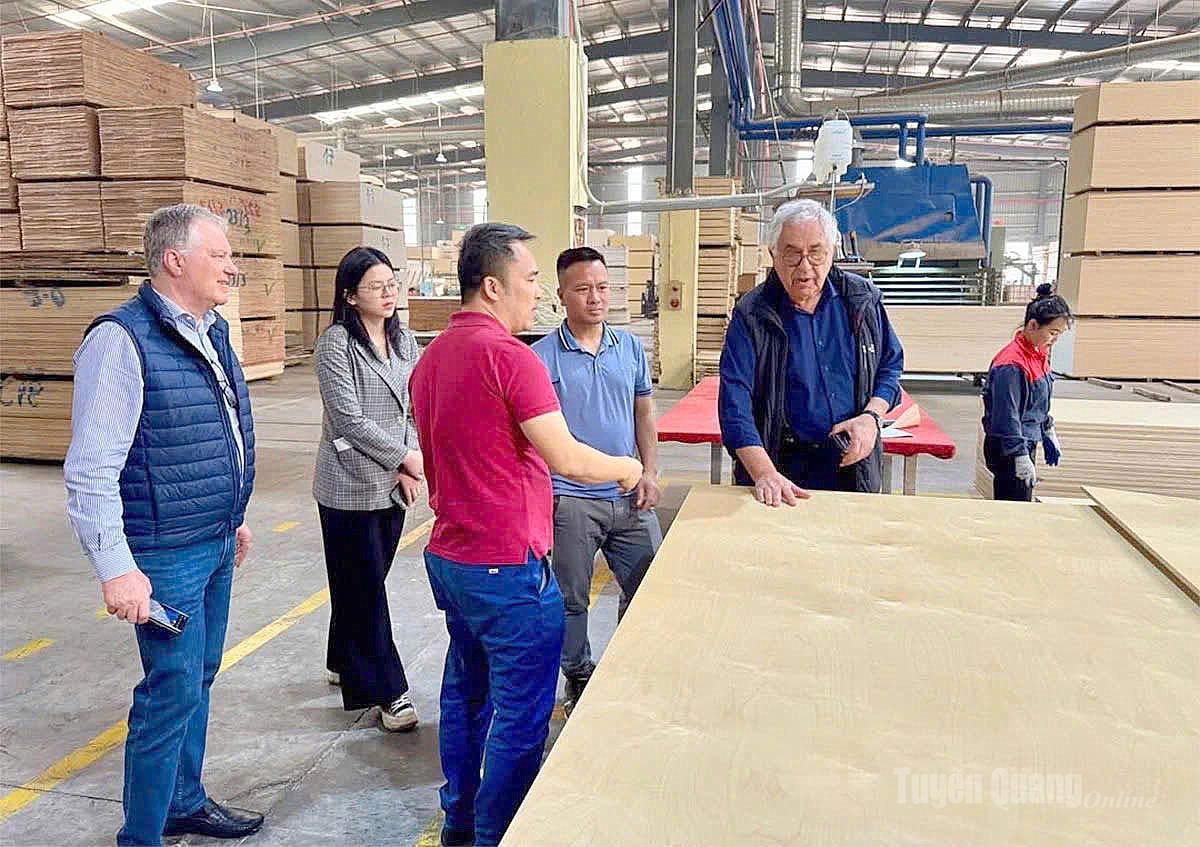
Foreign partners visit the export plywood production facility of Sao Viet Tuyen Quang Co., Ltd.
Sao Viet Co., Ltd. is a case in point. Rather than relying on traditional markets, the company has stepped up international engagement, welcoming delegations from the EU and Japan to assess its production processes and prepare for orders under the EVFTA and CPTPP. In the agricultural sector, signature products such as Xuan Van pomelos, guava tea, honey and male papaya flowers have also found their way into overseas markets, with direct exports to the UK benefiting from the preferential access provided by the UKVFTA.
Tran Viet The, Deputy Director of the Department of Industry and Trade, said: “The province is focusing on four key export groups: agricultural, forestry and fishery products; processed and manufactured goods; garments; and emerging export products. In 2026, the Department of Industry and Trade will serve as the focal point for selecting core businesses and cooperatives to join the FTA ecosystem. They will receive comprehensive support, ranging from legal advice and guidance on certificates of origin (C/O) to access to preferential financing and assistance in upgrading production to meet green and ESG standards and adopt circular-economy practices. This is key to helping agricultural and forestry products clear stringent technical barriers in export markets and move further up global value chains.”
The “Missing Link”: Standardising Production Areas
If businesses provide the route to market, the collective economic sector forms the backbone of organised production. There are currently 1,646 cooperatives in Tuyen Quang, with 37,300 members, including more than 1,000 agricultural and forestry cooperatives. These cooperatives account for more than 64% of the province’s 457 OCOP products.
Many cooperatives are already taking steps to meet stringent international standards. Su Anh Cooperative, for instance, has developed tea production linkages in line with ISO standards, while Sang Nhung Safe Food Production and Processing Cooperative has adopted a closed 3F/VietGAP livestock production model. Viet Thanh Broom Cooperative has successfully exported 40,000 products to the US market, generating VND 4.2 billion in revenue.
More importantly, cooperatives are increasingly serving as a vital link between producers and export markets, helping address stringent technical requirements - from maintaining cultivation records and obtaining growing-area and farming-area codes to applying sustainable forest management certification (FSC) and ISO processes. These are essential requirements for goods seeking preferential certificates of origin (C/O) and tariff preferences under the CPTPP, EVFTA and UKVFTA.
To create greater synergy, the provincial People’s Committee has issued a plan to implement the scheme on “An Ecosystem for Leveraging FTAs for the 2026-2030 Period, with a Vision to 2035”. The plan aims to build an integrated network linking government agencies, businesses, cooperatives and logistics providers. By 2030, Tuyen Quang aims to raise the utilisation rate of preferential C/Os to 15% under the CPTPP, 40% under the EVFTA and 42% under the UKVFTA. At the same time, more than 50% of entities in the ecosystem are expected to meet green-transition, circular-economy and other sustainability standards, enabling agricultural and forestry products to move further up global value chains.
Closer coordination among the authorities, businesses and cooperatives within the FTA ecosystem will create greater collective strength. In turn, free trade commitments can be translated into a tangible engine of growth, helping Tuyen Quang turn its ambition of double-digit economic growth into reality.
Nguyen Thanh Hieu
From Tuyen Quang online