Focusing on the Right Products
Over the first 11 months of 2025, Tuyen Quang’s industrial output was estimated at VND 30.2 trillion, up 21.8 percent year on year and reaching more than 90 percent of the full-year target. Particularly notable was the sharp expansion of technology-intensive manufacturing. Electronics, computers, and optical products surged nearly 77 percent, while textiles and garments rose more than 63 percent, reinforcing their role as key export drivers. Leather production increased by 22.75 percent, steadily expanding market share. Furniture and interior wood products climbed 28.35 percent, benefiting from abundant raw materials and strong overseas demand. Food processing posted more modest growth of nearly 6 percent, but continued to serve as a foundational sector, supporting both exports and domestic consumption.

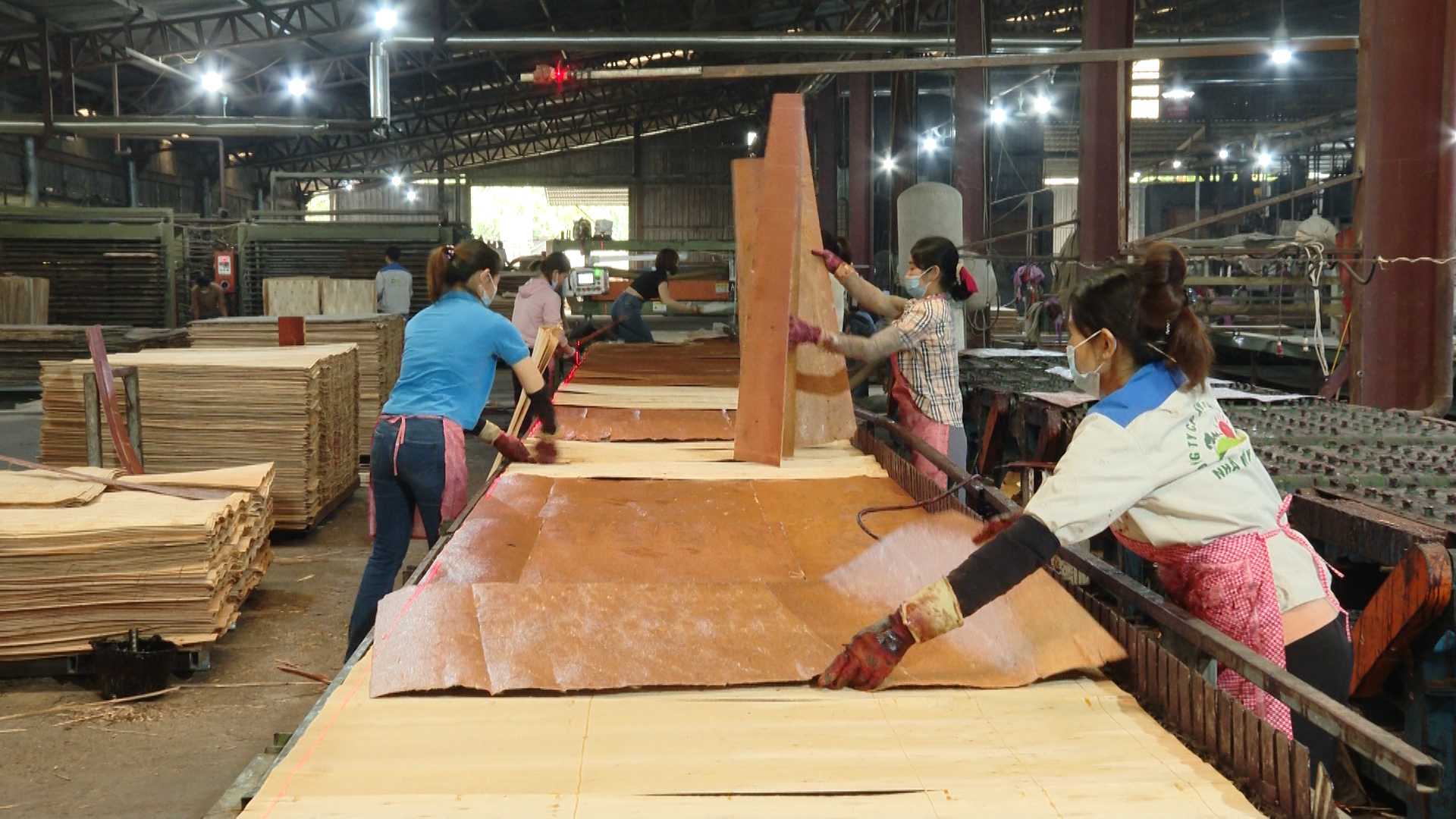
Wood processing for export at Woodsland Tuyen Quang Joint Stock Company
Wood processing remains a backbone industry of the province’s industrial landscape. Tuyen Quang is home to more than 500 wood-processing facilities, including eight large-scale enterprises with annual capacities ranging from 20,000 to 130,000 square meters. Products such as furniture, plywood, and wood pellets are now exported to high-standard markets including the United States, Japan, and the European Union.
According to Mr. Le Quang Khanh, Director of Woodsland Tuyen Quang Joint Stock Company, adaptability has been critical in navigating shifting global markets. In 2025, the company continuously adjusted designs to meet specific partner requirements while upgrading technology to comply with more stringent quality standards. As a result, Woodsland has secured a growing number of contracts from Europe, diversifying away from heavy reliance on the U.S. market. With orders already booked through the end of 2025 and into early 2026, the company is on track to meet its revenue target of VND 2 trillion.
Infrastructure and Policy Create Strong Pull Factors
To sustain industrial acceleration, Tuyen Quang has prioritized improvements to its investment climate, expanded support for businesses, and accelerated capital spending on industrial infrastructure. The province is pushing ahead with the development and upgrading of industrial parks and clusters, including Long Binh An Industrial Park, Binh Vang Industrial Park, the Thanh Thuy Border-Gate Economic Zone, and several industrial clusters such as Phuc Ung 2, Xuan Van, and Nhu Khe. These areas are being equipped with fully integrated transport networks, utilities, and telecommunications infrastructure.
Among them, Phuc Ung 2 Industrial Cluster has been proposed as the province’s first “smart industrial cluster,” applying digital technologies to optimize management, lower operating costs, and improve environmental performance. This model aligns with broader industrial digitalization trends and offers enterprises a competitive edge within regional and global supply chains.
Improved infrastructure and a more predictable policy environment have helped the province attract nine new investment projects, with total registered capital exceeding VND 3.5 trillion. Several projects are expected to reshape the industrial structure, including the Tuyen Quang biomass power plant, the Trung Son compressed charcoal pellet plant, factories producing eyewear and packaging, plush toy manufacturing facilities, and a VDL board processing plant.
Mr. Hoang Duc Tien, Deputy Director of the Department of Industry and Trade, said that following the provincial merger, authorities reviewed the entire industrial-cluster master plan, retaining only efficient clusters while adding specialized clusters dedicated to agro-forestry processing, medicinal materials, and high-tech manufacturing for the 2025–2030 period. At the same time, the province continues to roll out its industrial promotion program, supporting enterprises in adopting advanced technologies, upgrading production lines, improving packaging and product design, accelerating digital transformation, and transitioning toward cleaner production.
Laying the Groundwork for Sustainable Growth
Looking ahead, the Department of Industry and Trade has identified several priority tasks to ensure industry becomes a primary growth engine. These include completing industrial-park infrastructure, prioritizing clean and high-tech projects, strengthening key sectors such as electronics, renewable energy, wood processing, and agro-forestry manufacturing, and promoting circular-economy models that reduce waste and improve energy efficiency. Developing smart factories within industrial clusters and building a high-quality industrial workforce are also high on the agenda.
With a strategy centered on clearly defined growth drivers, decisive leadership, and consistent policy execution, Tuyen Quang’s industrial sector is well positioned for a sustained breakout. Industry is increasingly set to become a central pillar of the province’s economic expansion, providing a solid foundation for fast yet sustainable growth in the years ahead.
Nguyen Thanh Hieu
From a Vietnamese news on Tuyen Quang online