A Direction for Rapid and Sustainable Development
The consistent point of view throughout this revised planning is to achieve rapid yet sustainable socio-economic development. This is rooted in innovating development thinking, institutional reform, and a strong improvement of the business investment environment, while leveraging the roles of all economic sectors. Notably, the private sector is identified as one of the vital drivers of growth. Concurrently, the province emphasizes strengthening regional linkages, expanding cooperation and integration, and developing a synchronous infrastructure system - especially in transport and urban areas. This is regarded as a crucial condition to expand development space, attract investment, and enhance local competitiveness.
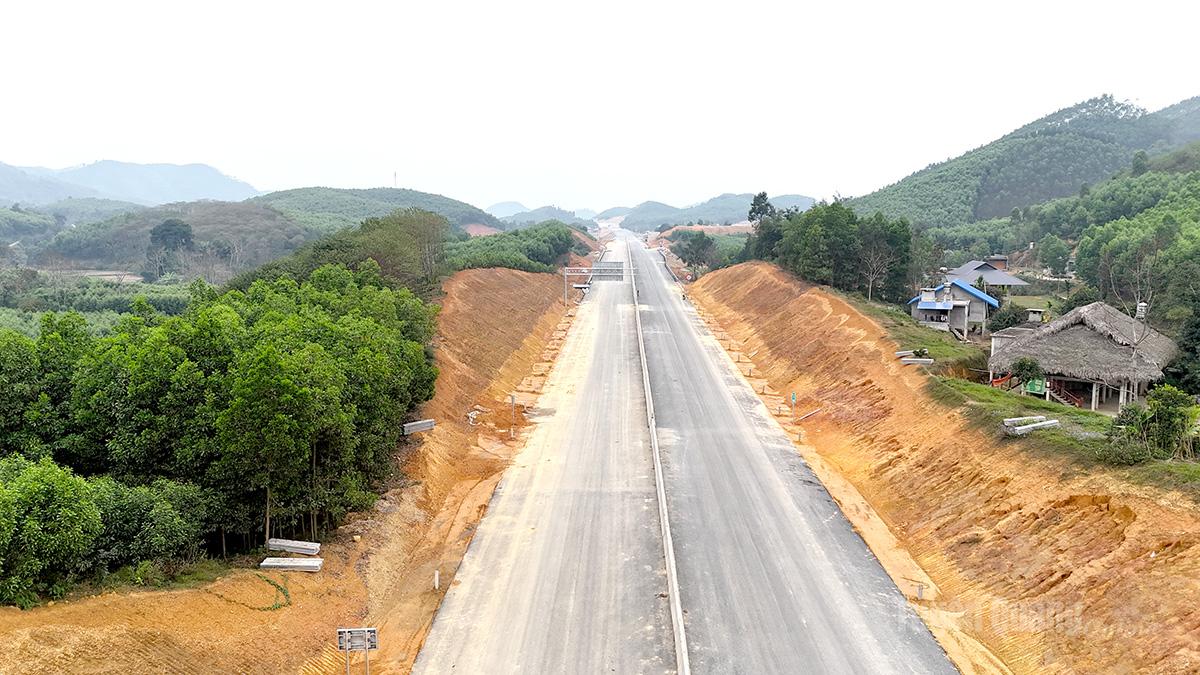
The Tuyen Quang - Ha Giang Expressway serves as the core transport infrastructure for the development driver axis
In the face of powerful economic transformation, science-technology, innovation, and digital transformation are identified as the primary catalysts for growth. Promoting technological applications in production, management, and service provision not only improves labor productivity but also creates new development models for the local economy. Furthermore, economic development must be inextricably linked to environmental protection and the effective use of natural resources, aiming toward a green growth model. The traditional cultural values and identities of ethnic groups are also defined as vital resources, providing the foundation for long-term development.
Secretary of the Provincial Party Committee, Mr. Hau A Lenh, affirmed: "Completing the provincial planning adjustment immediately after the merger is of particularly important significance. It marks a new stage in strategic vision planning, ensuring unity in development space and long-term growth momentum. This reflects a fresh development mindset and a scientific approach, opening a new era with a strong desire to rise and creating a foundation for a fast, sustainable breakthrough."
Closely Following the Provincial Party Congress Resolution
Based on these development perspectives, the planning determines objectives that strictly align with the Resolution of the 1st Provincial Party Congress. Tuyen Quang strives to become a fairly developed, comprehensive, and sustainable province in the Northern Midland and Mountainous region by 2030. The economic structure will continue to shift toward industry and services, while agriculture focuses on high-value commodity production through science and technology. Tourism is identified as a key economic sector to promote the province's image and growth.
Key targets set for 2030 include: Average GRDP growth (2026-2030): 10.5% year-on-year. Average per capita income: 95 million VND/year. Digital economy: Minimum of 20% of GRDP. State budget revenue: 12,000 billion VND. Labor productivity: Over 213 million VND/laborer. Tourism: Attracting 6 million visitors. Poverty reduction: Average decrease of 3-4% per year. Forest cover: 62.2%. In the vision toward 2050, Tuyen Quang strives to become a high-income developed province with a green, smart urban system and a sustainably protected ecological environment.
The planning adjustment will create more opportunities for localities located in new economic axes and spaces to be invested in synchronous infrastructure, expand development space, and provide commune-level localities with more conditions to attract investment, develop production and services, and increase income for the people.
Opening Development Space through a New Structure
This adjusted planning introduces new thinking in organizing socio-economic activities through a spatial structure of: 1 driver axis, 2 growth poles, 3 economic regions, 4 development corridors, and 5 development pillars. The Development Driver Axis: Stretches from the Thanh Thuy Border Gate Economic Zone (Ha Giang) to the Noi Bai - Lao Cai expressway, connecting key economic centers and facilitating the development of industry, trade, logistics, and tourism. Two Major Growth Poles: The Northern area associated with the border-gate economy and the Southern area centered on the Tuyen Quang urban area. Three Economic Regions: Divided by specific functions to optimize local advantages and regional linkages. Four Economic Corridors: Formed along major traffic routes to enhance intra-provincial connectivity and regional linkages with neighboring provinces like Thai Nguyen and the newly merged Lao Cai province. Five Economic Pillars: Infrastructure & urban development; Identity-based tourism; Agricultural-industrial processing chains; Border-gate economy & logistics; and Digital economy with high-quality human resources.
When these objectives are implemented synchronously, Tuyen Quang will possess the momentum to carve out a breakthrough, asserting its position as a bright spot in the Northern Midland and Mountainous region.
Nguyen Thanh Hieu
Vietnamese source: Tuyen Quang online